
01
Chronic Care Management
The program remote monitoring most often runs alongside.
Remote patient monitoring is the collection of a patient's physiologic data by a connected device outside the clinic, transmitted to the care team and acted on between visits. Medicare covers it for an acute or chronic condition where the monitoring is medically reasonable and necessary, and it is billed against both a data-collection requirement and a treatment-management time threshold.
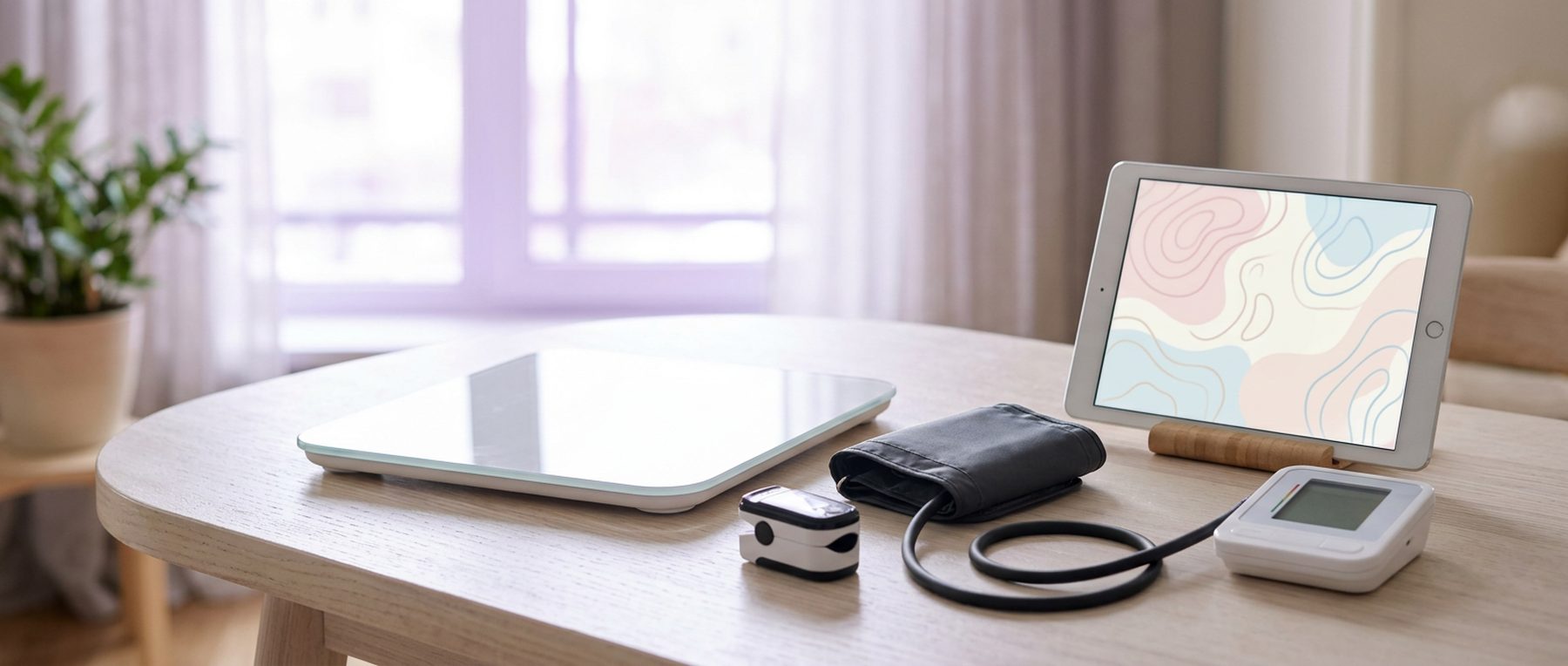
It works when the readings change what someone does. A device that produces a chart nobody acts on is a cost, not a program. The clinical value sits in the escalation path: who sees an out-of-range reading, how quickly, and what they are authorized to do about it.
It depends on the code. CMS states the requirement as 2 to 15, or 16 or more, days of data out of 30 days depending on the code descriptor. The day requirement does not apply to the treatment-management codes at all, which are billed on time rather than on readings.
This is worth stating carefully, because the widely repeated version of this rule is out of date. For years the answer was a flat 16 days out of 30, and a great many vendor pages and internal policies still say exactly that. CMS now describes a range that varies by code descriptor, which means a program configured to a single hard-coded threshold can both under-bill and mis-bill.
Because the descriptors are revised annually, the durable practice is not to memorize a number. It is to check the current descriptor for the specific code being billed, and to build the reading-day count into the record so the threshold can be demonstrated rather than asserted.
Remote physiologic monitoring and remote therapeutic monitoring cannot both be billed. Either one may be billed concurrently with chronic care management, transitional care management, behavioral health integration, and principal care management, subject to the usual requirement that time and effort are not counted more than once.

That makes remote monitoring one of the more flexible programs to layer, and one of the easier ones to account for incorrectly. A call that reviews a week of blood pressure readings and also addresses a chronic care goal has to have its minutes apportioned at the point of documentation, by the person who did the work.
The choice between physiologic and therapeutic monitoring is a clinical one about what is being measured, not a billing preference, and it has to be made per patient rather than per practice.
Usually because nobody owns the readings. Devices get distributed, data arrives, and no named person is accountable for looking at it daily or for acting when a threshold is breached. The second most common reason is device friction: equipment that needs a smartphone, home Wi-Fi, or a pairing step the patient cannot complete.
Cellular devices that work out of the box remove most of the enrollment attrition, because the patient does not have to succeed at a setup task to become a monitored patient.
The other half is thresholds. Population-default alert ranges generate volume that staff learn to ignore. Per-patient thresholds set against that patient's own baseline generate alerts that mean something, which is what keeps the escalation path credible.
It depends on the code being billed. CMS describes the requirement as 2 to 15, or 16 or more, days out of 30 depending on the code descriptor, and it does not apply to the treatment-management codes. The commonly quoted flat 16-day rule no longer describes every code, so check the current descriptor.
No. You may bill one or the other, not both.
Yes. Either remote physiologic or remote therapeutic monitoring may be billed concurrently with chronic care management, transitional care management, behavioral health integration and principal care management, provided the same time is not counted twice.
Not with cellular-connected devices, which transmit on their own. Requiring a phone or home Wi-Fi is one of the largest sources of enrollment drop-off, particularly in the older populations these programs most often serve.
Clinical staff under the billing practitioner's direction can monitor and triage, with escalation to the practitioner on threshold breaches. What matters is that the responsibility is named rather than shared.
The device and what it measures, the reading days supporting the data-collection code, the time supporting any treatment-management code, the interactive communication where the code requires it, and what was done in response to out-of-range readings.
The program remote monitoring most often runs alongside.
How concurrent billing and time separation actually work.
Program requirements on this page reflect CMS guidance current as of CY2026, drawn from the CMS Medicare Learning Network booklet Telehealth & Remote Patient Monitoring (MLN901705). Day thresholds are set by individual code descriptors and are revised annually; confirm the current descriptor for the code you intend to bill. This page describes the service and is not billing advice for a specific claim.
Remote Patient Monitoring is more than just a technological innovation; it's a new paradigm in healthcare that offers a blend of convenience, efficiency, and patient-centered care. If you or your loved one could benefit from RPM, reach out to your healthcare provider to explore how this service can be integrated into your care plan, ensuring continuous support and monitoring for a healthier, more independent life.
Contact us