Independent Physician Practices

A New Operating Layerfor Advanced Primary Care

Advanced primary care management changed what CMS reimburses: a standing relationship with a Medicare patient rather than minutes on a timesheet. Praventa runs the operating layer that makes that relationship deliverable. Continuous data from the hospitals and specialists who see your patients, round-the-clock clinical access beyond what your practice staffs, and a care team that stays with the panel between visits. An always-on model your practice runs on, without adding payroll and without joining a network.

Praventa Supports Independence

A management organization's infrastructure. Without joining one.

A care coordination team at workstations on an open, daylit operations floor, each clinician on a headset with a patient record open.

When an independent practice sells to a health system, or signs with a management services organization or an independent physician association, it is usually buying one thing: operational infrastructure it cannot build at its own scale. Centralized care coordination. After-hours coverage. Population analytics. A connection to the hospitals and specialists who see its patients. Reporting it can stand behind.

Praventa exists to supply that layer directly to the practice instead. The same streamlining of clinical operations and the same extension of clinical capacity, delivered as a service your practice buys rather than as a condition of an affiliation your practice joins.

No new personnel on your payroll. No capital outlay from the practice. Your ownership, your governance and your contracts stay exactly where they are.

That distinction matters most to the practice that does not want to affiliate at all. An MSO or IPA relationship typically arrives with membership terms, shared governance and contracting through the group. A service relationship arrives with none of it. It changes what your office can do on a Monday morning and leaves the question of who owns the practice entirely alone.

Advanced primary care management, reported with G0556, G0557 and G0558, is what makes that reachable for a small practice for the first time. It is a monthly bundled payment per patient, stratified by complexity rather than by effort, and it carries no monthly time threshold at all, so the bundle pays for precisely the capability the layer supplies. The infrastructure that used to be the reason to sell is now the thing Medicare is willing to fund you to keep.

Extended Clinical Capacity

What always-on infrastructure adds to a small practice

A monthly bundle pays for a relationship that does not switch off between visits. A practice can only hold up its side of that if the information keeps arriving and somebody is always there to act on it.

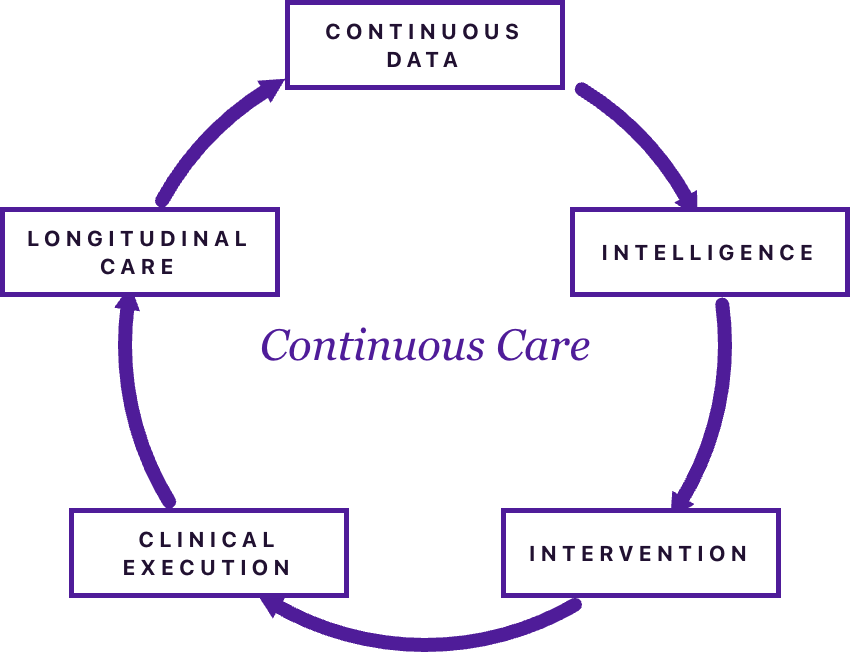
A loop diagram: continuous data leads to intelligence, intelligence to intervention, intervention to clinical execution, clinical execution to longitudinal care, and longitudinal care back to continuous data, with continuous care at the center.

Praventa connects once, through the Trusted Exchange Framework and Common Agreement and its designated Qualified Health Information Networks, and through state and regional data exchange frameworks. Your practice does not run that project and does not staff it.

Two kinds of information come back. Event notifications tell us the moment one of your patients is admitted, transferred or discharged, anywhere that reports. Longitudinal records tell us what has happened to that patient across every facility that contributes, not only what is written in your chart.

That is the difference between learning your patient was in the hospital and learning it the same day, while the window to act on it is still open.

Access runs the same way. Advanced primary care management requires round-the-clock access to the care team, and Praventa provides it above and beyond what your own practice staffs. A patient who deteriorates at nine on a Saturday evening reaches a clinician rather than a voicemail greeting, and what happens in that call comes back to you as part of the record.

The practical effect is that a two physician practice can offer its Medicare patients what it previously could not: someone present between visits, a medication review by a pharmacist, after-hours access to a clinician who can see the chart, and a care plan that is maintained rather than written once. Those are the services that keep an older patient out of the hospital. They are also, quite often, the services a patient leaves a small practice to go and find.


What We Supply

What Praventa supplies against the service elements

Because the bundle pays on elements being in place rather than on minutes documented, the only question that matters is what is actually covered, and by whom. Here are all thirteen service elements, and which of us supplies each one.

Service element
What it requires
Responsibility
01Patient consent
Captured once at enrollment and documented.
Praventa
02Initiating visit
Only for new patients, and only the billing practitioner can do it.
Your practice
0324/7 access to care
A clinician reachable at any hour, beyond what you staff.
Praventa
04Continuity of care
A named pharmacist or nurse practitioner who stays with the patient.
Praventa
05Comprehensive care management
Needs assessment, preventive review and medication reconciliation.
Praventa
06An electronic care plan
Built and maintained, shared with your team and the patient.
Praventa
07Management of care transitions
Discharge alerts, outreach in two business days, follow-up to you.
Praventa
08Coordination with community-based services
Referral to home and social services, documented in the care plan.
Shared
09Ongoing patient communication
A reliable route to the care team during business hours.
Praventa
10Enhanced communication
Secure messaging and asynchronous channels beyond the telephone.
Praventa
11Population-level data analysis
Care gaps and medication risk surfaced across the whole panel.
Praventa
12Risk stratification
The panel ranked so deterioration is visible before it happens.
Praventa
13Performance measurement
Outcome reporting from us; MIPS or MVP reporting stays with you.
Shared

Praventa also runs eligibility and tier identification, including the monthly dual-eligible and qualified Medicare beneficiary screening that determines which of the three codes applies. That is billing-level work rather than a service element, which is why it sits outside the thirteen.

What Stays Yours

What does not change when you bring Praventa in

Extending clinical capacity is only worth doing if the practice is still yours at the end of it. Everything below stays where it is.

01

Your patients stay your patients

The panel is yours, the charts are yours, and the relationship is between the patient and your practice. Praventa works behind your name, not alongside it. Patients are told the care team is an extension of their physician's practice, because that is what it is.

02

The initiating visit stays with you

For a new patient, or one not seen recently, advanced primary care management requires an initiating visit that only the billing practitioner can furnish. That is a CMS requirement rather than a Praventa preference, and it is the one service element we cannot supply for you.

03

The claim stays with your practice

Your practitioner reports the code and your practice is paid. Praventa does not bill Medicare for your patients. What we return is the documentation behind the claim: what was done, when, by whom, and against which service element.

04

Clinical decisions stay with your practitioners

Our pharmacists and nurse practitioners assess, reconcile, escalate and document. Anything that changes a plan of care comes back to your physician. The model extends the hours your practice can cover, not the authority over how it practices.

05

Quality reporting stays in your name

MIPS and MVP reporting belongs to the practice and continues to. What Praventa supplies is the outcome and utilization data underneath it, which is usually the part a small practice is least equipped to produce for itself.

06

Your options stay open

If the practice later joins an ACO, an IPA or a management organization, the care management layer goes with it rather than being the reason you had to join. Building the capability first means that decision stays a choice about strategy instead of a response to not having the infrastructure.

Common Questions

Related questions

Can a small independent practice bill advanced primary care management?

There is no practice-size threshold in the codes. What the codes require is that the billing practitioner serves as the continuing focal point for the patient's primary care and that the practice can furnish the required service elements each month. Size is not the barrier; capability is, which is the gap an outsourced clinical layer is meant to close. Eligibility for any individual patient still depends on your own documentation and your Medicare Administrative Contractor's policy, so confirm before enrolling a panel.

Is there a time requirement for advanced primary care management?

No, and this is the clearest break from every other care management code. The monthly payment is stratified by patient complexity rather than by documented minutes, so the reporting question is whether the required service elements were in place, not how long they took. For a practice that cannot reliably capture and document a minute threshold every month for every eligible patient, that single difference is what makes the program runnable at all.

Can transitional care management be billed in the same month as advanced primary care management?

Not for the same patient in the same period. The bundle incorporates elements of transitional care management, along with chronic and principal care management, so those are not separately reported while the patient is being managed under it. This catches practices out, because transitional care is usually the program they are already running. The right sequence is to decide which patients belong under the bundle before enrolling them, rather than discovering the overlap on a denied claim.

Does advanced primary care management replace chronic care management, or add to it?

It replaces it for that patient and that period. Whether the trade is favorable depends on the panel rather than on the code descriptors. A panel where documented time reliably clears the chronic care management thresholds behaves differently under a bundle than one where it does not, and that is an analysis of your own data. Praventa runs it with you before any patient moves.

Which of the three codes applies to a given patient?

Chronic condition count and qualified Medicare beneficiary status. G0556 covers patients with one or fewer chronic conditions, G0557 covers patients with two or more, and G0558 covers patients with two or more who are also qualified Medicare beneficiaries. Because that last status can change month to month, the screening behind it is recurring work rather than a one-time check, and Praventa runs it.

What is a qualified Medicare beneficiary, and why does it have its own code?

A person enrolled in a Medicaid program that pays their Medicare premiums and cost sharing. Providers may not bill a qualified Medicare beneficiary for Medicare cost sharing, which is part of why this population is separated into its own level. For an independent practice serving a lower-income panel, this is worth understanding early, because it affects which patients can be enrolled without a cost-sharing conversation.

Does the practice need to hire staff to run the program?

No. The work that consumes staff time is the non-face-to-face work: identifying the discharge, reaching the patient inside the required window, reconciling medications, maintaining the care plan and documenting all of it. Praventa performs that remotely. Clinical staff may furnish those elements under the billing practitioner's general supervision, which is what makes the model work without adding payroll.

Does working with Praventa require joining an ACO, IPA or management organization?

No. Praventa contracts directly with independent practices, and the arrangement does not require affiliation with any network, nor does it place the practice under one. If you already belong to an ACO or IPA the model still works, but it is not a precondition. The point of building the capability directly is that it stays with the practice regardless of what you decide about affiliation later.

How does hospital discharge information reach a small practice in time to act on it?

Through the exchange layer rather than the fax machine. Praventa connects to the Trusted Exchange Framework and Common Agreement and its designated Qualified Health Information Networks, and to state and regional health information exchanges, then routes real-time admission and discharge notifications into the workflow. Timing is the whole point: a discharge you learn about on day four is a discharge whose window has already closed.

Talk to us about your practice

Tell us how many Medicare patients you carry and what you run today. We will tell you what the bundle looks like against your own panel, and what it would take to start.

Contact Praventa